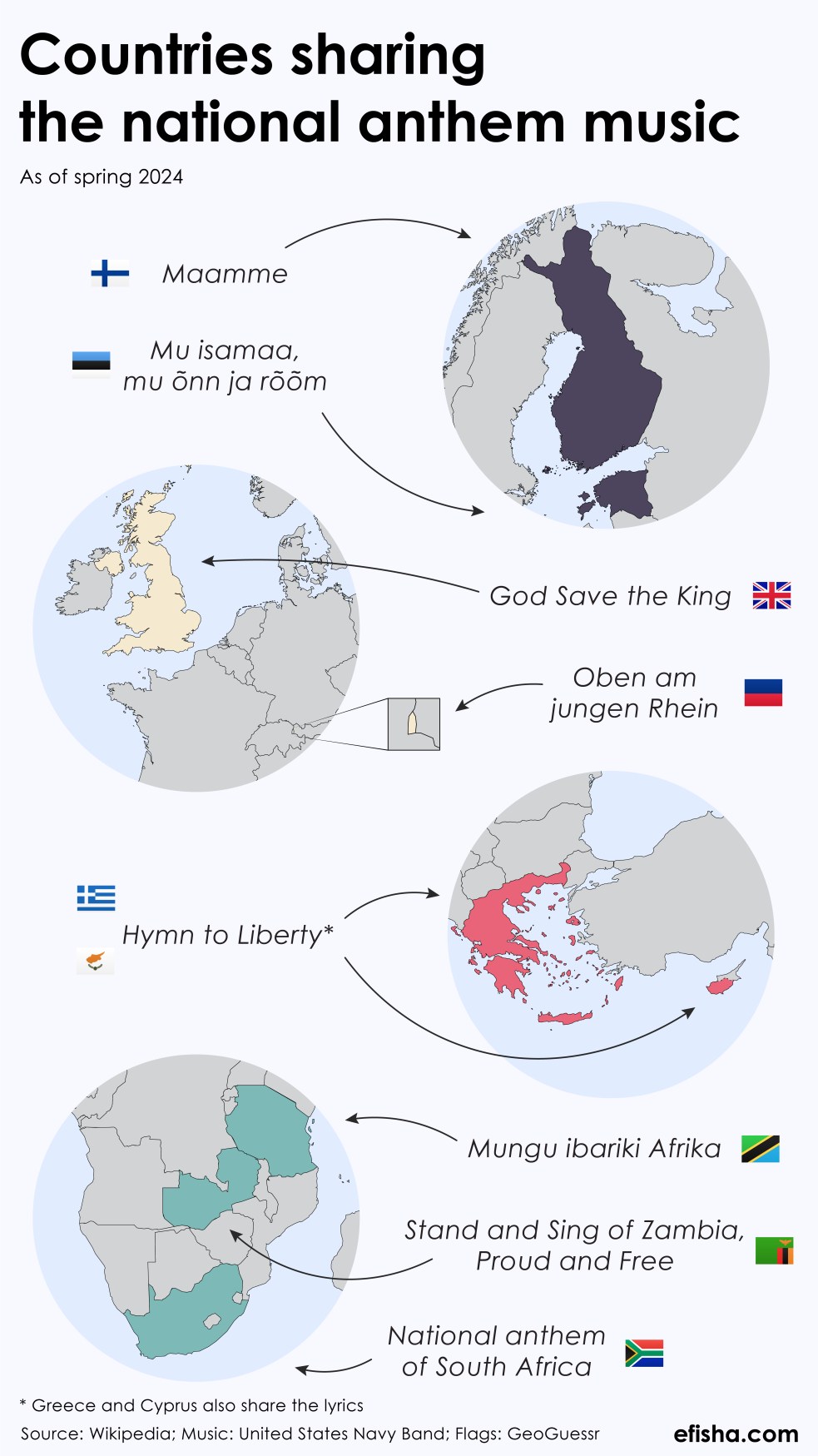
Same anthem, different countries

Not all countries have their own unique anthem. Some share the music and the pair of Greece and Cyprus even share the lyrics! In the 19th century, the situation was even less diverse. Not only because there were fewer countries and half the world basically belonged to a handful of them, but also because of the British anthem. As one might expect, it was used throughout the empire. As one might not expect, the music to it has also been used by Russia, Sweden, Iceland, Siam, Greece, Hawaii, Prussia, Hanover and Saxony at different moments.

Nowadays, some might also say that Chilean and Bolivian anthems sound strikingly similar, but officially they are 2 different melodies composed by 2 different people.

If you know any other national anthems that share the music or you want to share or ask something, send me a message using the contact page.
How to indicate a question in writing or what other question marks are out there

When making this map on how to ask what time it is in European languages, I discovered that the Greek question mark is actually very different from the question mark used in other languages in Europe. So I decided to research what other signs are used as question marks in other languages and to my surprise, there were only a handful of other options besides the good old “?”.

Here’s the source.

Top corporate tax rates around the world

Taxation usually comprises a large chunk of a government’s budget and a sizeable part of it comes from corporate income tax. Attitudes toward taxation differ per country with some preferring lower rates to entice businesses and some preferring higher rates. Nevertheless, even when tax rates are pretty high, companies in some countries manage to avoid paying taxes altogether maximising their profit and decreasing the positive impact they might have on society (looking at you, Jeff). So although it is undoubtedly interesting to get an overview of top corporate tax rates worldwide, it does not mean that companies in these countries actually pay taxes based on these rates.

Some values on the map do not represent the real-world situation fully: Bahrain doesn’t have a general corporate income tax, but they do tax oil companies at a rate that can be as high as 46%; similar applies to the UAE, where each of the 7 emirates is allowed to levy their own corporate income tax up to 55%, however, in practice this tax is only applied to foreign banks and petroleum companies; on Comoros, the rate of 50% applies only to “public industrial and commercial enterprises or those where the state or certain public institutions are participants … if their turnover exceeds 500 million Comorian francs”. The normal tax rate is 35%.

Here you can find the source and here you can read about their methodology.