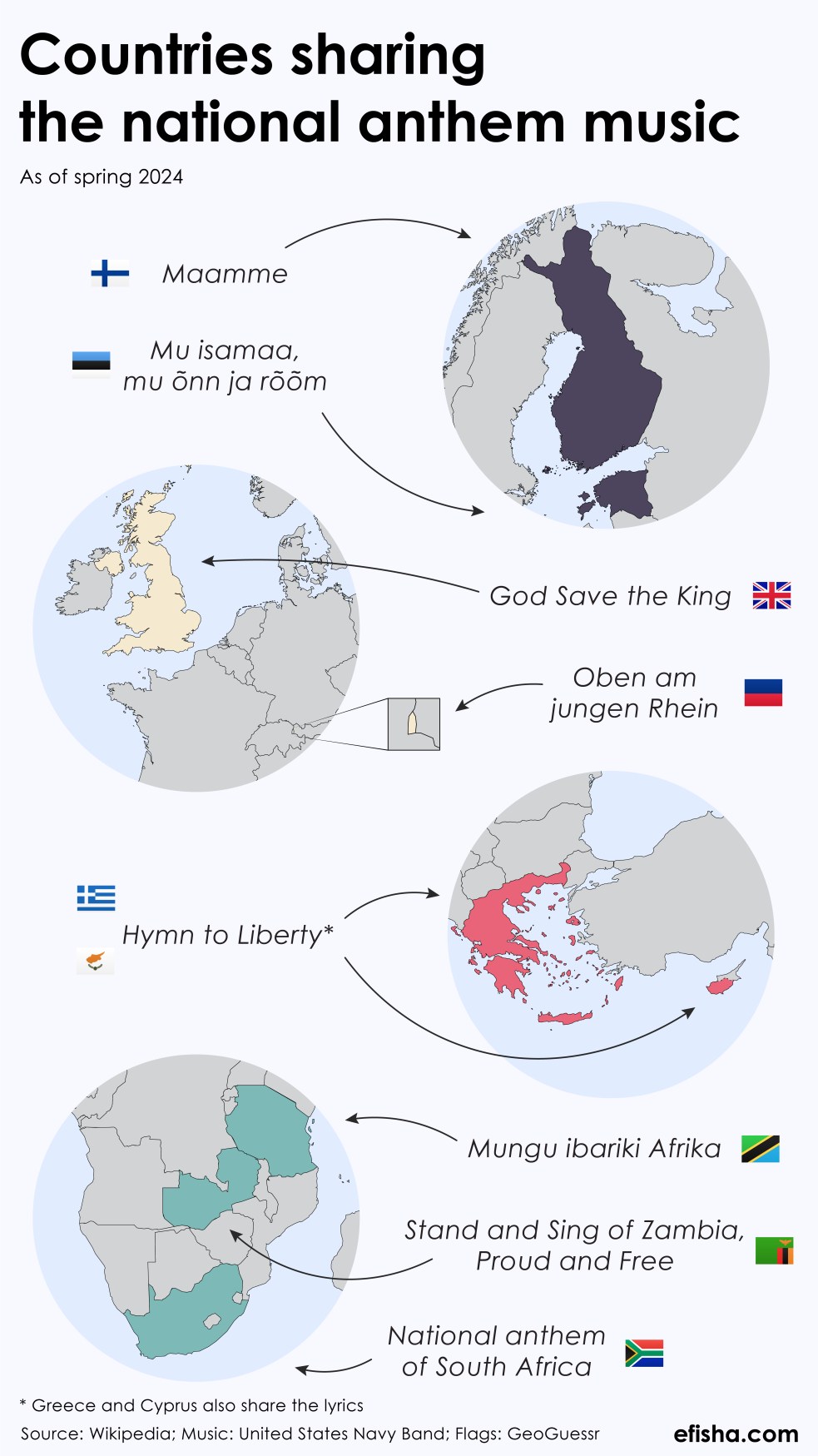
Same anthem, different countries

Not all countries have their own unique anthem. Some share the music and the pair of Greece and Cyprus even share the lyrics! In the 19th century, the situation was even less diverse. Not only because there were fewer countries and half the world basically belonged to a handful of them, but also because of the British anthem. As one might expect, it was used throughout the empire. As one might not expect, the music to it has also been used by Russia, Sweden, Iceland, Siam, Greece, Hawaii, Prussia, Hanover and Saxony at different moments.

Nowadays, some might also say that Chilean and Bolivian anthems sound strikingly similar, but officially they are 2 different melodies composed by 2 different people.

If you know any other national anthems that share the music or you want to share or ask something, send me a message using the contact page.
How to indicate a question in writing or what other question marks are out there

When making this map on how to ask what time it is in European languages, I discovered that the Greek question mark is actually very different from the question mark used in other languages in Europe. So I decided to research what other signs are used as question marks in other languages and to my surprise, there were only a handful of other options besides the good old “?”.

Here’s the source.

Biathlon events history since the start of the World Cup

If you wanna find a very European sport, or to be even more precise, a very Central / Eastern European one, then search no further, biathlon got you covered. In the last 55 years, since the World Cup as we know it started, 396 biathlon events, including world cup stages, world championships and the Olympics have been held and only 29 (or 44 if you include the Russian stages that technically happened in Asia) of them were held outside of Europe. Wanna find a sport where 1 nation is above everyone else and 1 athlete is so good if he has a good day no one has a chance of beating him? Biathlon. Wanna find a sport with a great atmosphere both among the fans and the athletes? Biathlon. Wanna find a sport where things change in a matter of seconds and you know exactly at what moment it will get exciting? Biathlon. I just love it.

Working students

Striking how stark the differences between Northern/Central and Southern/Eastern Europe are when it comes to the share of students who have jobs! This map shows only the share of the employed, however, in Northern European countries many students are still unemployed, meaning that they are looking for work but at that moment did not have one. The share of those can be as high as 14% in Sweden, 9% in Finland and 7% in the Netherlands. It means that over 3/4 of all students in the Netherlands want/need to have or already have a job!

More info including gender-based data can be found here.

Population change since 1840

Bizarre how there are countries (which are not just city-states) where more people lived 180 years ago than there are now. It’s only 1 country, and the difference is still significant: 8,221,292 in 1840 vs 4,986,525 now. The reasons? Well, first of all, the Great Famine in the 1840s. It resulted in 1 million dying and 1 more million fleeing the country. The next half a century was not that desperate but the conditions on the island were still harsh with rising prices, a lack of jobs and poor harvests. So more people left. There are only around 5 million Irish living in Ireland now, while more than 35 million live in the US, more than 14 in the UK, more than 7 in Australia and more than 4,5 in Canada. So although the population of Ireland itself decreased, the number of Irish people only grew. Or at least descendants of Irish people.

Here’s the source and of course, we don’t exactly know how many people lived in many places in 1840 so although this data might be considered reliable it is not 100% correct.

“Were you born in a barn?” in European languages

I’ve always been interested in how proverbs and certain expressions translate to other languages and for the last few weeks, I was exploring what people in different European countries say when someone enters a room/house and leaves the door open. There are a lot of great options but my personal favourites are Portuguese, Italian and Turkish. Keep in mind, that these are only selected versions, more expressions conveying the same meaning exist in most of the countries!

While some of the expressions seem obvious, like the German or the Ukrainian one as they imply a place where doors close by themselves, others are much less straightforward and have interesting history behind them. The Portuguese one, for instance, might be going back centuries! As one of the theories claims, in the 16th century, an extra gate was built into the city walls of Braga, but because it was quite a peaceful period in the city’s history and because it already started sprawling outside the walls, they didn’t install a door to block the gateway. Thus, the notion that people from Braga do not close doors was born.

The Dutch expression comes from the fact that church doors often stay open for people to come in. The Czech one I assume comes from the idea that if you have a pole in your arse you need to leave the door open the pole gets into the room/house to. Many Slavic languages also have a version about having a tail, I assume, for the same reasons.

The main source for this map was the AskEurope subreddit, although for some languages I had to mobilise native speakers in their own subreddits and a few friends of mine.